
The Village—or is it?
Scads of young people who live, laugh, and love in The East and West Villages are dropping the “the” prefacing “village.” I’d noticed it myself on TikTok and wrote it off as a weird affectation that would eventually disappear. But now that it’s New York Times official, is it here to stay?
A recent Styles section piece surveyed the linguistic phenomenon online and on the street, capturing both sides of the debate in a “born and bred, cantankerous” New Yorker’s irritation (“The! The! The!” he says in response to a young woman’s referring to “West Village”) and a sixteen-year-old girl’s prickly indifference (“We already know where we’re going. We don’t have to say unnecessary things.)”
Back in 2022, journalist Calder McHugh connected the grammatical shift to social media’s echo chambers in Hellgate. The creators that he spoke to copped to being inconsistent, but they didn’t seem bothered by that. If you’re a 23-year-old transplant whose limited understanding of the area comes from fellow 23-year-old transplants, why would you be?
This New Yorker’s gut-reaction is that it sounds wrong and therefore it must be wrong. But as I discovered while writing my book Like: A History of the English Language’s Most Hated (and Misunderstood) Word, just because something doesn’t sound right doesn’t mean it’s incorrect. “What’s being observed is a fairly common practice,” Alexandra D’Arcy, Professor of Linguistics and Director of the Sociolinguistics Research Lab at the University of Victoria, says.
D’Arcy clarified that it’s not grammatically incorrect to drop the “the” determiner in these instances, pointing out to me that British English routinely elides such articles in ways that flummox the American ear (take “she’s in hospital” versus “she’s in the hospital).” She continued: “In English generally, we delete determiners when we are focused on a function, rather than a place.” Proper nouns are an exception to this rule. “The East Village” sounds perfectly normal to people who live in New York. For someone new to the city, it sounds as odd as “The Hague.”
If there’s an objective argument to be made for the article’s importance, it’s that it’s unique, and ergo special to New Yorkers otherwise inured by the city’s constant transformations. When you omit the determiner from a place name, it starts to represent something more generic: a “way of being, an ethos associated with a place,” as D’Arcy describes it.
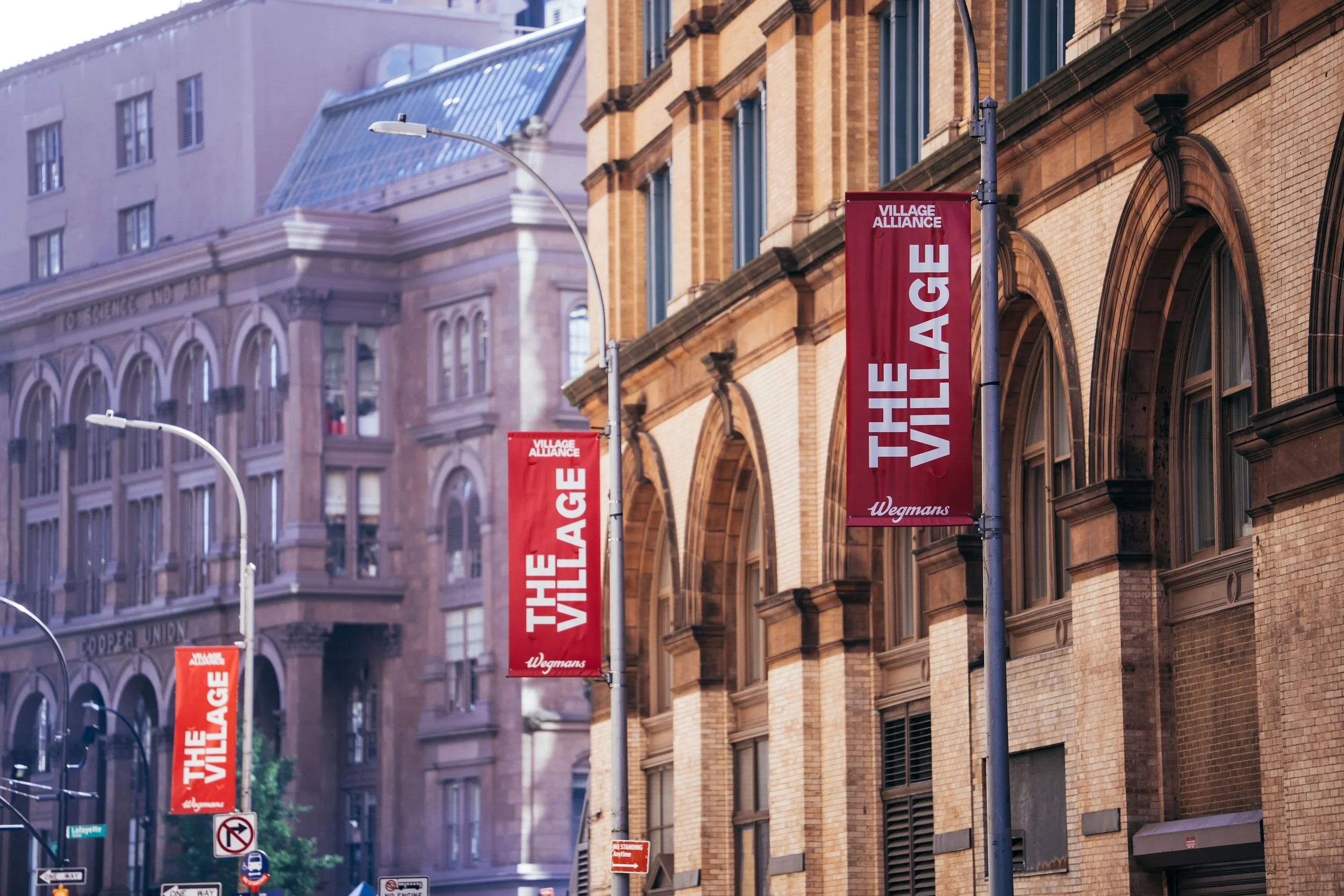
I’d characterize it as a kind of “user-friendly” branding. As a point of contrast: Village Alliance’s lamppost banners (which say “The Village,” for the record) are ubiquitous along 8th Street. It’s not wrong to say that that St. Mark’s Place and Carrie Bradshaw’s old stomping grounds don’t have the same vibe, but the signage serves a purpose for placemaking. They welcome visitors like a confident host, politely repeating their name for pronunciation.
The Village “proper” is mostly spared in the debate; the Times reports that the commentariat seem to agree that that name “usually refers to Greenwich Village.” And on that note, McHugh’s reporting in Hellgate provides some sobering context: “The East Village is only called what it is because of developers and landlords attempting to connect it in spirit to Greenwich Village in the 1960s.”
Language change is always led by young people, but specifically women, who are largely responsible for creating and consuming the type of aspirational lifestyle content that’s implied to be the primary culprit behind the “the” erasure. . Combine that with unprecedented exposure and power in the influencer economy and the griping starts to appear like a new take on a tired tradition: policing women’s speech. I wrote a book on the subject! I’m guilty as charged. But now, I’m well. aware of how this relatively minor complaint makes me sound old.
“Neighborhood nomenclature is such an integral part of New York’s lore that it becomes something like a personality trait for its residents. Times journalists Alisha Haridasani Gupta and Gabriella Gershenson write. “It is hardly a surprise, then, that any perceptible shift in the city’s mores—even the omission of a three-letter article—would divide its inhabitants, pitting the new versus the classic, the young versus the old.”
(D’Arcy is more blunt: “The folks who are bothered by this are not the ones at the forefront,” she says. Heard!).
I suppose I can learn to live without the article. If Gen-Z content creators stick around for ten years, I suspect they’ll develop the same precious tendencies as me and my pro–“the” peers. But by then, they’ll have earned it.
